Inspecting galvanised metal is a crucial stage. Hot-dip galvanising protects steel from corrosion for decades, but only if the zinc coating meets the relevant standards. How can a customer check this parameter themselves, quickly and with professional accuracy?
Let’s look at the physics of the process, the correct equipment and the rules for taking measurements.
What instrument should be used to take the measurement? (And why an automotive one won’t do)
The main mistake many customers make during inspection is using cheap automotive paint thickness gauges (designed to check car paintwork) or devices intended solely for thin-film electroplating.
What’s the problem?
Hot-dip galvanising is not simply a layer of paint on top. When metal is immersed in molten zinc, a complex iron-zinc alloy (a diffusion layer) is formed. Cheap devices and automotive sensors ‘get confused’: they detect the iron within the zinc coating itself and produce critically low or erratic results.
What should you use?
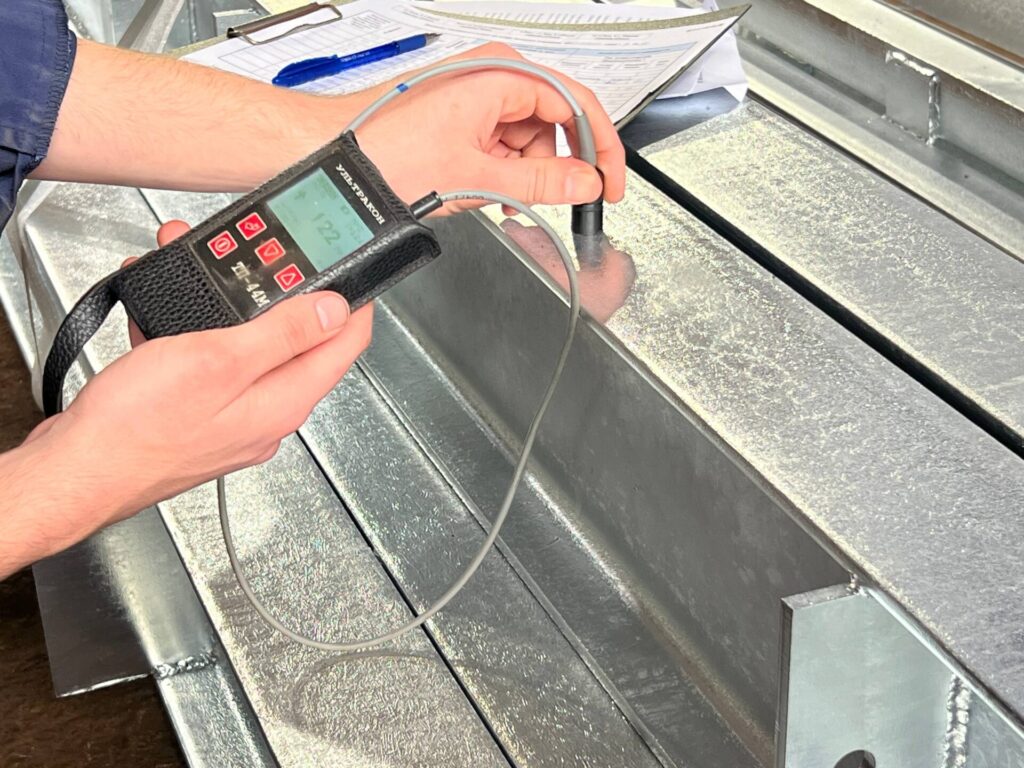
For professional and indisputable acceptance testing of steel structures in Ukraine, the quality standard is expert-level equipment from the market leader in non-destructive testing — NVF ‘Ultrakon’. The optimal choice is the TP-44M magnetic coating thickness gauge.
The most important rule: The TP-44M device must be fitted with an F2-type magnetic sensor. The F2 sensor is specifically designed for testing hot-dip galvanised coatings. The use of automotive ‘beepers’ or unsuitable sensors will result in incorrect readings. The TP-44M must be set to measure in micrometres (mkm).
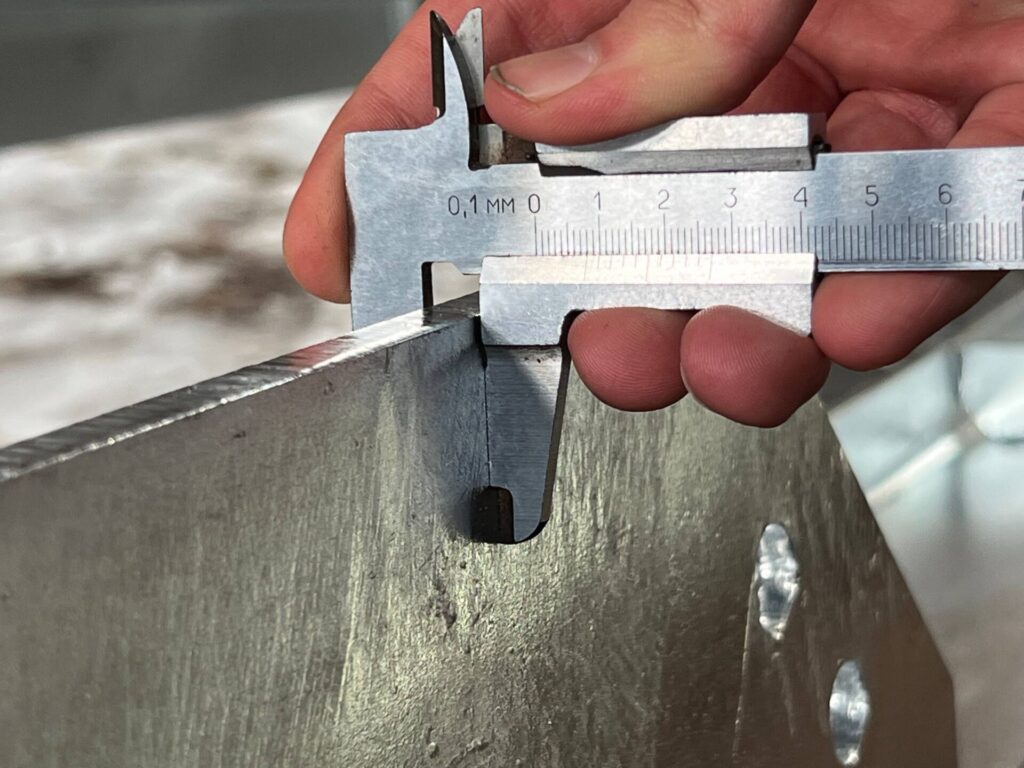
At the Metal Invest Plant, the minimum average thickness of the hot-dip galvanised coating, in accordance with DSTU EN ISO 1461, is 85 mkm for steel over 6 mm thick, 70mkm for steel between 3 and 6 mm thick, and 55 µm for steel between 1.5 and 3 mm thick. The thicker the metal, the thicker the zinc layer required by the standard.
Hot-dip galvanising protects steel from corrosion for decades, but only if the thickness of the zinc coating complies with the standards. This article sets out the specifications in micrometres, explains what affects the thickness of the zinc coating, and provides a step-by-step guide on how to check the coating when accepting steel structures.
Zinc coating thickness specifications in accordance with DSTU EN ISO 1461
The standard specifies two parameters: local (minimum at any point) and average (based on a series of measurements on the product). The average thickness is used as a guide when accepting a batch.
| Product and steel thickness | Minimum mean coating thickness, µm | Minimum local coating thickness, µm |
|---|---|---|
| Steel over 6 mm | 85 (610 g/m²) | 70 (505 g/m²) |
| Steel from 3 to 6 mm | 70 (505 g/m²) | 55 (395 g/m²) |
| Steel from 1.5 to 3 mm | 55 (395 g/m²) | 45 (325 g/m²) |
| Steel under 1.5 mm | 45 (325 g/m²) | 35 (250 g/m²) |
| Castings 6 mm and above | 80 (575 g/m²) | 70 (505 g/m²) |
| Castings under 6 mm | 70 (505 g/m²) | 60 (430 g/m²) |
Table for products not treated by centrifugation (metal structures, supports, masts, sections); for metal fittings and small parts, a different table from the standard (centrifugation) applies.
To avoid confusion: in quick reference guides, the standard is often referred to by a single figure — this is the average coating thickness: 85 mkm for thick metal, 70 mkm for medium-thickness metal, and 55 mkm for thin metal.
What determines the thickness of hot-dip galvanising
Hot-dip galvanising is not simply a coat of paint on top. When the metal is immersed in molten zinc, an iron-zinc alloy (diffusion layer) forms on the metal; therefore, the thickness of the coating depends on:
- the thickness of the steel — the thicker the metal, the thicker the zinc coating. Profiles with thicknesses of 7 and 12 mm fall within the same range (over 6 mm), so the standard for them is the same;
- the chemical composition of the steel — reactive steel with a high silicon content is galvanised extremely quickly, and the zinc layer on it turns out thicker;
- the geometry of the product — proximity to edges, holes and welded joints alters the distribution of the coating.
Why ‘more zinc’ is not always better
Sometimes, a single welded structure combines components made from different grades of steel. If reaction steel is present, keeping the product in the molten zinc for extra time ‘to achieve the required thickness’ on the standard components is impractical and dangerous. On reactive steel, the zinc layer becomes excessive and brittle, creating a risk of reduced adhesion: the coating flakes and peels away from the metal upon even slight mechanical contact. The process engineer always seeks a balance to avoid damaging the product: the standard is the minimum required, not the goal of ‘the thicker, the better’.
How to measure the thickness of a zinc coating: which thickness gauge to choose
The thickness of a hot-dip galvanised coating is checked using a magnetic thickness gauge fitted with a sensor specifically designed for hot-dip galvanised coatings and calibrated in micrometres (mkm). Cheap automotive thickness gauges (for paint on car bodies) and devices designed for thin electroplating are not suitable for this purpose: hot-dip galvanised coatings contain an iron-zinc alloy, so the readings from such devices may be underestimated or unstable.
An example of a device for professional acceptance testing in Ukraine is the TP-44M magnetic coating thickness gauge from the ‘Ultrakon’ Research and Production Enterprise. For hot-dip galvanising, it is fitted with an F2-type magnetic sensor; without this, or with an unsuitable sensor, the readings will be inaccurate.
Cleanliness, contact pressure, edges: 4 rules for accurate measurement
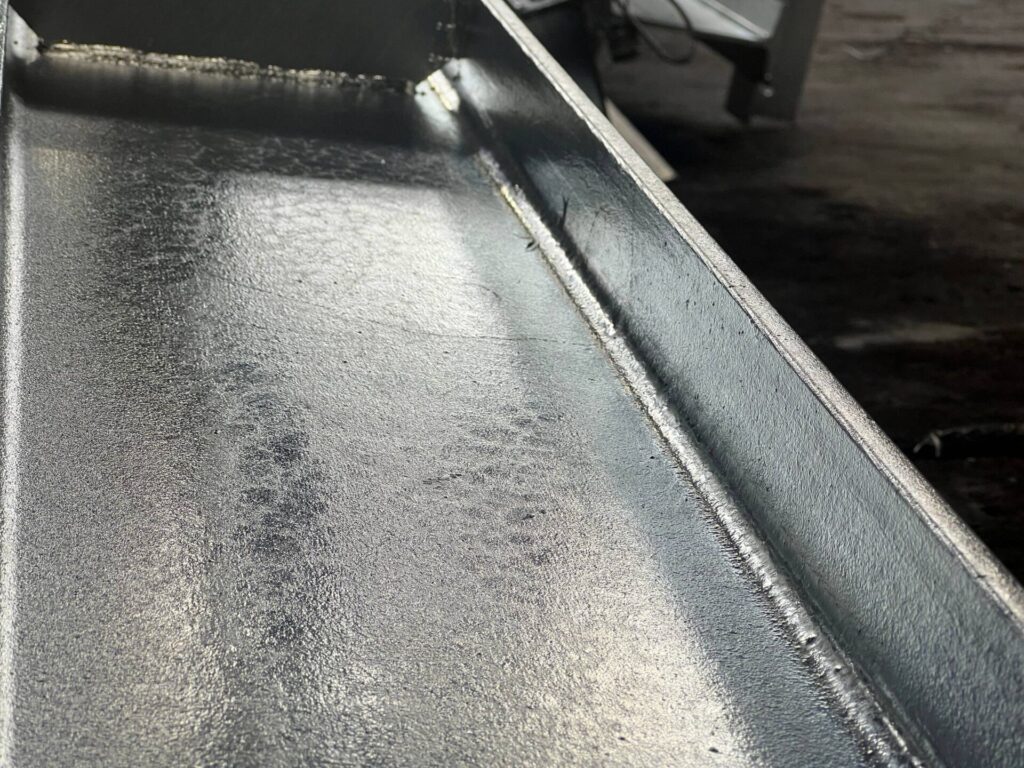
Clean surface. The metal at the measurement point must be dry and free from dirt, grease and white tarnish (the result of natural zinc oxidation).
- Clean surface. The metal at the measurement point must be dry and free from dirt, oil, grease and white deposits (products of natural zinc oxidation).
- Perpendicular probe placement. Hold the probe perpendicular to the surface and press it firmly into place in one steady movement, without tilting. Do not slide the probe across the metal: place it, record the reading, then lift it.
- Keep away from edges and welds. Avoid taking measurements near component edges, holes, corners and weld areas. Keep the probe at least 10–15 mm away from any edge.
- Account for the geometry. When measuring a round pipe, position the probe so that its axis aligns with the pipe’s radius.
Methodology for the acceptance of galvanised steel structures based on significant surfaces
To ensure the inspection is objective, a representative sample is required:
- Distribute measurements evenly. For a long beam, column or support, take several measurements at the beginning, middle and end. If a component has several faces, take more measurements on the larger faces.
- Follow the steel thickness range. Assess components within the same thickness range together. For example, measurements on 7 mm and 12 mm sections are combined into a single assessment (over 6 mm).
- Check the average value. Take a series of 5–10 measurements across the significant surfaces of components within the same thickness range, and use the instrument’s automatic averaging function. Coating quality is assessed using the average, rather than a single reading.
- Treat the structure as a single item. If a welded structure consists of components within the same steel thickness range, assess it as a whole; there is no need to measure every channel, angle or plate individually.
What is not measured: stiffeners, gussets, brackets
Small components — gussets, stiffeners, brackets — cannot be checked with a thickness gauge. Due to their complex geometry, proximity to edges and welded seams, they cause an ‘edge effect’ that distorts the sensor’s magnetic field, and even a precise instrument will display incorrect readings. Coating thickness is assessed only on the main significant surfaces.
The ‘next product’ rule: when a measurement shows a borderline value
If a measurement at a particular point on a single product yields a borderline result, do not rush to reject the batch. Hot-dip galvanising is a complex physico-chemical process, and the procedure requires you to take the next product from the same batch (with components within the same thickness range) and repeat the test. The quality of the batch is assessed based on the overall sample.
Frequently asked questions about the thickness of the zinc coating
What is the minimum thickness of hot-dip galvanising?
For steel over 6 mm thick — 85 µm (average) and 70 µm (local); for 3–6 mm thick — 70 and 55 µm; for 1.5–3 mm thick — 55 and 45 µm.
What is the difference between the average thickness and the local thickness?
The average thickness is the result of a series of measurements taken on the product; the local thickness is the minimum permissible value at a single point.
How many measurements need to be taken?
A series of 5–10 measurements across the significant surfaces of the component within a single thickness range, distributed proportionally across the surface areas of the faces.
Can the zinc thickness be measured on stiffening ribs and near welds?
No: the edge effect distorts the readings. Move at least 10–15 mm away from the edge.
What should be done if a measurement is at the limit of the specification?
Do not reject the batch immediately: take the next product from the same batch and repeat the check
Why can’t you simply add more zinc if the thickness is insufficient?
On reactive steel, additional holding time in the molten bath results in a brittle excess layer and the risk of the coating flaking off.
Hot-dip galvanising of steel structures in Cherkasy with quality control standards
‘Metal Invest’ carries out hot-dip galvanising on its own production line with a 14-metre bath, so we can protect even large steel structures without cutting them. Production capacity is up to 500 tonnes per month, with a full production cycle: from cutting and fabrication to galvanising. We also accept hardware and small metal structures for processing on our new galvanising line.
Would you like to calculate the cost or clarify the coating thickness requirements for your product? Submit an enquiry at metalinvest.ua